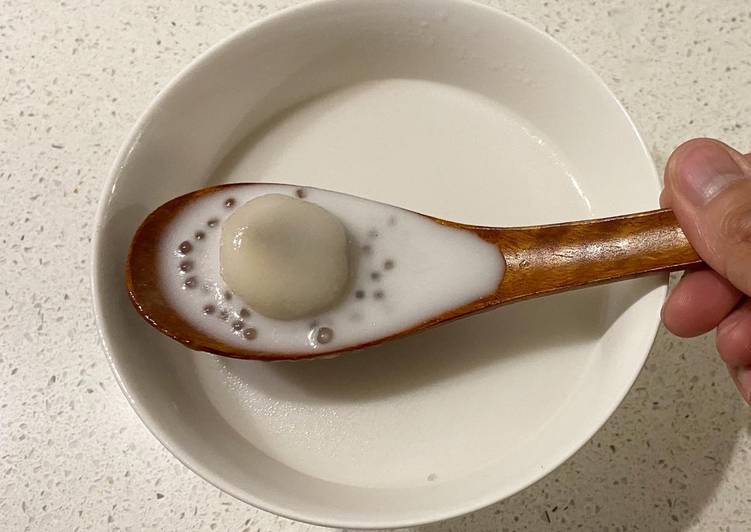
Hey everyone, hope you’re having an amazing day today. Today, I’m gonna show you how to prepare a distinctive dish, glutinous rice balls with sago in coconut milk dessert. It is one of my favorites. For mine, I am going to make it a little bit tasty. This is gonna smell and look delicious.
Glutinous rice balls with sago in coconut milk dessert is one of the most favored of recent trending foods on earth. It is simple, it is quick, it tastes yummy. It is appreciated by millions every day. Glutinous rice balls with sago in coconut milk dessert is something that I’ve loved my entire life. They are fine and they look fantastic.
Thai Dessert - Glutinous Rice Flour Dumplings in Coconut Milk (Krong Krang Nam Ka Ti). A sweet Filipino snack/dessert of sticky rice balls, tapioca pearls and mixed fruits cooked in coconut milk. Made with glutinous rice balls, plantain bananas, sweet potatoes and tapioca pearls that is Cooking sago or tapioca pearls could take a while, depending on the size.
Guide to Prepare Glutinous rice balls with sago in coconut milk dessert
To get started with this recipe, we have to prepare a few components. You can cook glutinous rice balls with sago in coconut milk dessert using 14 ingredients and 7 steps. Here is how you cook that.
Ingredients
The ingredients needed to make Glutinous rice balls with sago in coconut milk dessert:
- Get To cook sago:
- Make ready 30 g Sago (add more or less depending on preference)
- Make ready 3-4 cups cold water
- Make ready Glutinous rice balls:
- Take 80 g Glutinous Rice Flour
- Get 8 g sugar
- Make ready 30-40 ml Water
- Take To cook the glutinous rice balls:
- Get 15 glutinous rice balls
- Prepare Water for cooking glutinous rice balls (enough water to cover)
- Get To make coconut sugar syrup:
- Take 1 can coconut milk or cream (400ml can)
- Take 200 ml water
- Get 10-20 g rock sugar (use more or less depending on preference)
Water (colour from plants or flowers). U can use beetroot for red and pumpkin for yellow. Mix coconut milk, water, sugar, salt and pandan leaves. Coconut balls are an easy Chinese dessert recipe made with sticky rice flour that can be found at This recipe for coconut balls uses glutinous rice flour - also called sticky rice flour - which is Place the glutinous rice flour in a large mixing bowl.
Instructions
Instructions to make Glutinous rice balls with sago in coconut milk dessert:
- In a small saucepan on medium heat, pour in hot water and bring to a boil. Once boiling add the sago and cook until the balls become clear and translucent. Tip: more water may need to be added if it runs low.
- Once sago is cooked immediately rinse under cold water, using a sieve to catch all of the sago. Set aside. *If not adding rice balls skip step 3 and move on to step 4.
- In a large mixing bowl, add the glutinous rice flour and sugar. Stir and then add bit by bit the water (you may not need to use all of the water). Stir with chopsticks or a fork until all of the ingredients are combined. Then use your hands to gently knead the dough (if dough does not form, add a bit more water at a time. Continue to knead until it forms a ball).
- Pinch a bit of dough at the time and shape into round balls. The balls should weigh roughly 6 grams each (make larger or smaller depending on preference). Place balls on a baking tray or plate and cover with a clean tea towel or cling film to prevent them drying out. Repeat step 4 until all of the dough has been used.
- In a small saucepan, on medium heat, add water and bring water to a boil. Once water boils add the rice balls and cook for roughly 3 minutes. Stir occasionally with a spatula to prevent the balls sticking to the bottom of the saucepan. Once the rice balls float to the top. Remove them from the sauce pan. Immediately rinse under cold water and place in a bowl and set aside.
- In a medium size sauce pan on medium to low heat, add the coconut milk and rock sugar. Gently heat up the coconut milk and constantly stir to ensure the milk does not boil and the sugar dissolves. Once all of the sugar has dissolved, taste to see if it to desired sweetness (if not add more sugar). Once coconut milk is warm, turn heat to low and transfer the sago into saucepan. Mix well and turn off heat.
- Using a ladle pour coconut sago mixture into the bowls and eat and serve immediately while hot. If adding rice balls, add into the bowl and mix it into the mixture and enjoy while hot. If your prefer having it as a cold dessert, cover with cling film and put it in the fridge for a short time. Take out of fridge when ready to eat. It is tasty hot or cold depending on preference.
Slowly add the sweetened condensed milk, using a. Glutinous rice balls in sweet syrup is an Asian dessert usually enjoyed during the Winter Solstice Festival. Also known as 'kuih ee' by the Peranakan Traditionally, these glutinous rice balls are made without any filling. In recent years, many types of flavours such as peanuts, Kaya (coconut jam). While the balls still warm, gently roll them in grated coconut to cover it evenly.
As simple as that How to Prepare Glutinous rice balls with sago in coconut milk dessert
So that is going to wrap it up with this special food glutinous rice balls with sago in coconut milk dessert recipe. Thank you very much for your time. I’m confident you can make this at home. There’s gonna be more interesting food at home recipes coming up. Don’t forget to bookmark this page on your browser, and share it to your family, friends and colleague. Thank you for reading. Go on get cooking!
Print this page


